
Incredible Facts About The Brain

*It turns out the brain is not fixed at childhood; it continues changing throughout life. This is evidenced in stroke patients who, when enthusiastic about recovery, can come back strong and develop compensatory neural pathways, despite their age. It seems reluctance to learn in later years comes more from a mental unwillingness to try, rather than a physical limitation.

An open, active mind is a healthy one.
Although we really knew it all along, neuroplasticity research confirms it. The brain is like a series of muscles. If you exercise one part of your mind, that part will grow until it plateaus. To keep you brain from withering, learn new things from time to time. Take your mind out of its comfort zone. Switch between music, math, poetry, mechanics, art, and whatever else you can to keep your brain fit and nimble.

The brain can develop just by thinking.
In a landmark study where participants were taught to play the piano, researchers found that simply imagining practicing the piano resulted in brain development similar to those who actually physically practiced. It seems the right frame of mind and a can-do attitude must exist before you develop a skill, rather than the other way around. Simply going through the motions isn’t what develops your mind, the thought process itself does.

Happiness and sadness can be learned.
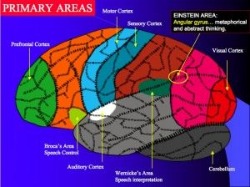
Despite temporary fluctuations, the mind tends to quickly return to its baseline happiness level. Some of the highest happiness baselines are found in Buddhist monks. In studying their brain patterns, it was found that the part of their brains associated with happiness (their left prefrontal cortexes, as shown, in green) were highly developed, indicating an ability to “train” themselves to be happy and elevate their baseline levels. Conversely, someone who practices negative thinking will develop their right prefrontal cortex, which is associated with negative moods, thus lowering their baseline.


This is an excerpt from Brain Plasticity: You Can Teach An Old Dog New Tricks. It can be found online at www.noprobo.com

March 12th, 2009

Brain Plasticity & Neurogenesis

Muscles Activate Brain Receptors

When acetylcholine is released at a neuromuscular junction, it crosses the tiny space (synapse) that separates the nerve from the muscle. It then binds to acetylcholine receptor molecules on the muscle fiber's surface. This initiates a chain of events that lead to muscle contraction.

Scientists have shown that muscle fiber contains a scaffold made of special proteins that hold these acetylcholine receptors in place. Research led by Jeff W. Lichtman, M.D., Ph.D., at Washington University School of Medicine in St. Louis, indicates that a loss of nerve signals – due to inactivity – actually disassembles this scaffold and causes a loss of acetylcholine receptors. When the muscle becomes active again, however, the scaffold tightens its grip and catches any receptors that come by.


"So muscle activity is a cue to keep a synapse stable, and synaptic inactivity is a cue to disassemble a synapse," says Lichtman, a professor of neurobiology. "So if you lose activity, you lose receptors. But if you regain activity, you get those receptors back."

This article was taken from "The Human Brain" By The Franklin Institute Online. It can be found at www.fi.edu


describe the image


describe the image


describe the image describe the image

Follow Kidsfit